
Staffing shortage at NIH risks grant numbers this fiscal year

A bi-weekly newsletter where I share news, opinion, grant opportunities, success tools and tips on personal growth.

Oliver's Note
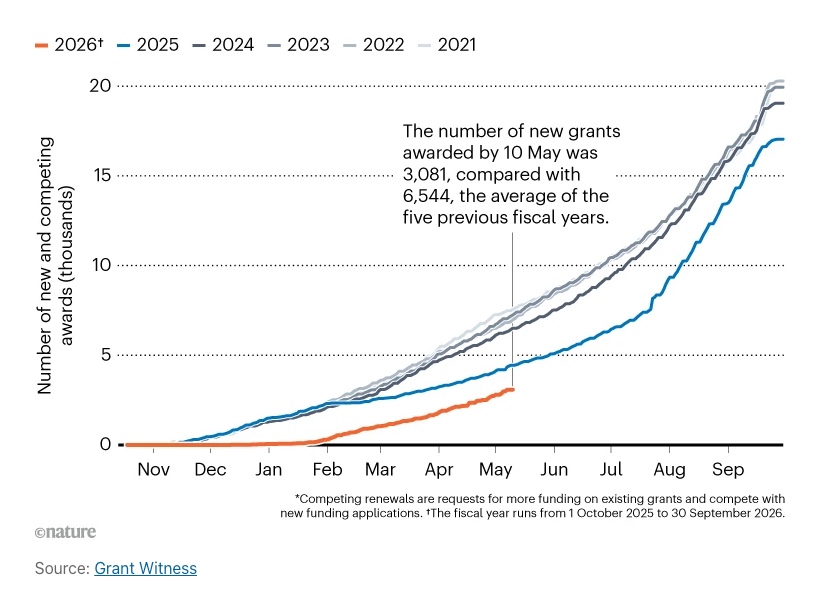
Staffing shortage at NIH risks grant numbers this fiscal year
The NIH has roughly $47 billion to spend this fiscal year. The problem, according to newreporting from Nature, isn't the budget — it's the people needed to move it out the door.
So far this fiscal year, the NIH has awarded less than half the number of new grants it had issued by the same point, averaged over the previous five years.
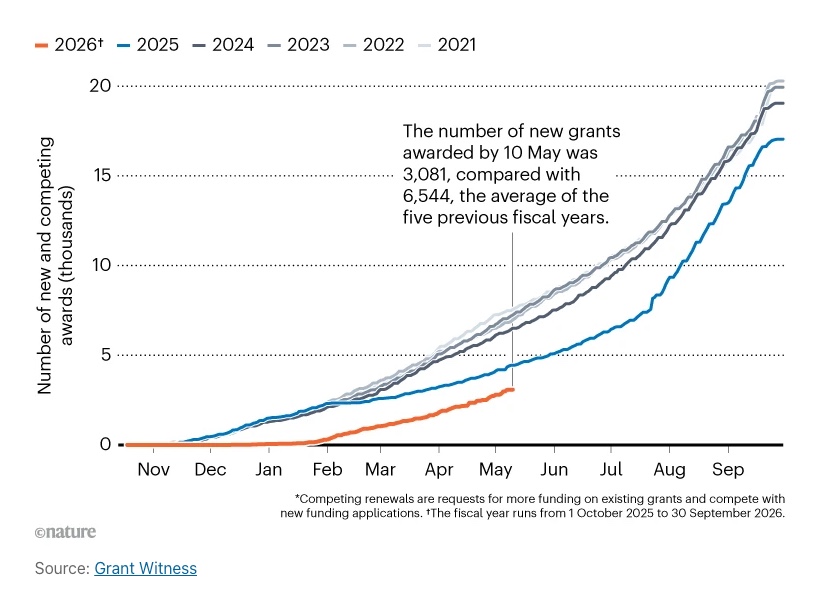
While there are likely several factors at work, Nature's investigation suggests that a shortage of grants management specialists (GMSs) — the staff who handle the business and administrative side of issuing awards — is slowing the agency's ability to spend its money. Many GMSs resigned or were laid off in 2025 as the federal workforce was downsized, and nearly 20% of NIH employees left over the year.
The effect is most visible at the National Institute of Mental Health. Internal documents obtained by Nature show NIMH projected in March that it could issue only about 5% of the new awards it gives out in a typical year, and that one institute has asked early-career researchers in NIH's own labs to volunteer temporarily as grants specialists.
NIMH normally funds 900–1,000 new awards a year; with volunteers stepping in, it has so far managed about 133. Staffing is not the only factor. A 43-day government shutdown, a White House delay in releasing the approved budget, and an added grant-screening review process have all contributed, but the materials indicate insufficient staffing is the main bottleneck at several institutes.
The mechanics matter for grant seekers. Because the NIH is legally obligated to pay out continuing awards, understaffed institutes have prioritized those renewals,leaving less capacity to review and issue brand-new grants. Any budget unspent by 30 September must be returned to the US Treasury.
If you have a new application in the pipeline, this is a useful reminder that funding timelines this cycle may be slower and less predictable than the score on your summary statement would suggest. It's worth staying in close contact with your Program Officer, confirming budget and start-date expectations rather than assuming them, and building contingency into project planning. None of this changes how to write a strong application, but it's a good year to plan for patience.
The takeaway: A well-reviewed grant still depends on people to process it. When you can, build flexibility into your timelines and keep the lines open with your Program Officer.
In Case You Missed It
A new journal to elevate scientific rigor?
Science reportson Dr. Bhattacharya's recent call.

Jay Bhattacharya, NIH Director and acting director of the US Centers for Disease Control and Prevention (CDC), has called for a new, externally reviewed CDC journal to "elevate scientific rigor".
This comes after he pulled a study on COVID-19 vaccine effectiveness from the CDC's Morbidity and Mortality Weekly Report (MMWR) and questioned the peer-review process at MMWR.
Bhattacharya's actions have been met with criticism from former CDC officials and epidemiologists, who argue that MMWR already has a rigorous internal review process and that the test-negative methodology used in the pulled study is a valid approach.

Growth Mindset
Plan Six Months Out, Not Six Weeks
Successful grant applications don't happen in the final sprint; they're built over months.
I recommend beginning to plan six or more months before a deadline: clarifying the science, identifying collaborators, reviewing the NOFO, and laying out a realistic timeline.
Writing begins around three months out, starting with the Specific Aims.
The final month is for polishing, collecting letters, and meeting your institution's internal deadlines, which often fall well before the NIH due date.
The grant isn't due when NIH says it's due; it's due when your research office says it's due.
The takeaway: Work backward from the deadline — then add two weeks.
Success Tools
Peer review training with preprints
Darian Carroll and Anna Hatch of HHMIrecently shareda new twist on training early career scientists in peer review.

The Howard Hughes Medical Institute (HHMI) has developed a peer review training program called Transparent and Accountable Peer Review (TAP) that uses preprints on bioRxiv to train early-career scientists.
The TAP program includes a one-day workshop and hands-on practice sessions where participants learn to write public peer review reports on preprints, with the goal of providing constructive feedback to authors and advancing research.
The program has shown positive results, with 89% of participants reporting it was a good use of their time and 92% feeling prepared to appraise manuscripts independently, and HHMI is exploring ways to share the program with the broader scientific community.