NIH Funding is good for business
A bi-weekly newsletter where I share news, opinion, grant opportunities, success tools and tips on personal growth.
Oliver's Note
NIH funding is good for business
It should come as no surprise that NIH funding does more than advance biomedicine–it also stimulates the economy,
United for Medical Research (UMR), a coalition that promotes biomedical research funding,recently updated an analysisthat demonstrated how awards from the National Institutes of Health (NIH) increased economic activity through jobs and revenue.
They found that the National Institutes of Health (NIH) awarded $36.58 billion in research grants in Fiscal Year 2025, supporting 390,863 jobs and generating $94.15 billion in new economic activity.
That translates into every $1 invested in NIH research generating $2.57 in economic activity, resulting in a 250% return on investment.
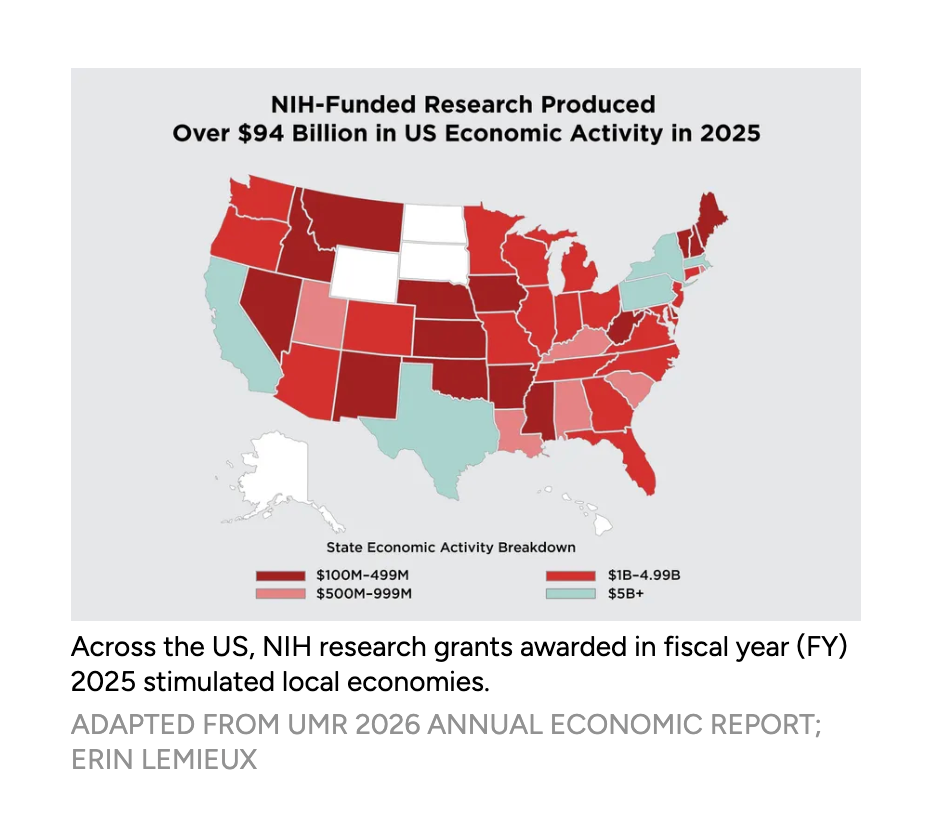
As the map above shows - NIH dollars flow into many states. While California, Texas, New York and Massachusetts lead the pack, many states receive over $100M.
Over the last decade, NIH funding has generated $822 billion in economic activity and supported 3.7 million jobs nationwide, making it a critical bipartisan priority for preserving U.S. innovation and global leadership.
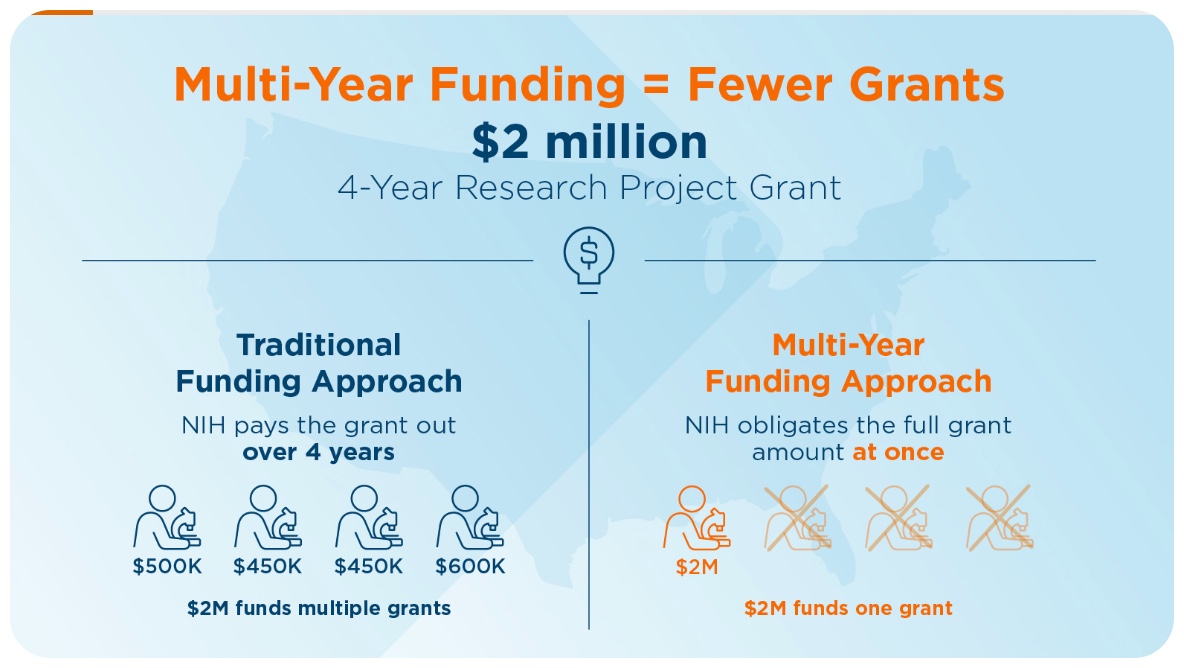
The report also specifically points out the economic impact of the current NIH rush towards multi-year funding.
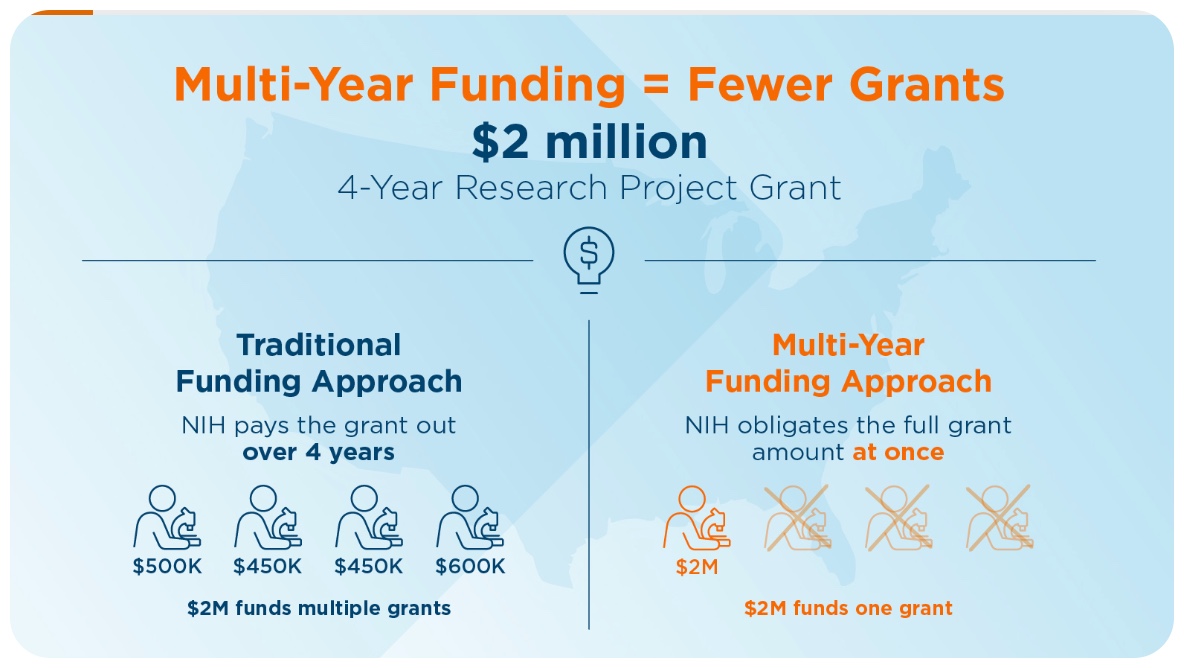
I have written about this before–multi-year isn't inherently bad, and in fact it gives funders like NIH more flexibility to weather fluctuations in the Congressional budgets. It is the transition that hurts. UMR's graphic makes it easy to understand. What is key in the discussion of ROI from R01s is that under multi-year, while the money is all committed up front, it is not spent any faster - and of course you need to spend it to see the ROI.
I guess I will never understand why an administration intentionally throttles a funding stream that has a proven track record of improving human health and growing our economy.
In Case You Missed It
The 2025 NIH grant terminations hit different
In a recent PNAS paper,How the 2025 NIH grant terminations varied by researchers’ demographic groupsby Oliveira et al., takes a close look at who was affected, What they found is not a surprise, but devastating nonetheless.
Check out the paper here:https://doi.org/10.1073/pnas.2527755123
The main findings:
The 2025 NIH grant terminations affected 2,291 active research grants, resulting in aloss of $2.45 billionin funding.
Early-career investigators, including assistant professors, postdoctoral scholars, trainees, and graduate students, were disproportionately affected by the grant terminations.
Womenwere also disproportionately affected:
59.8% of terminated projects among assistant professors wereled by women.
Women-led projects were smaller in value, with median awards of $0.94M versus $1.4M for men, resulting in reduced financial flexibility for women investigators.
These terminations disrupted the biomedical research pipeline, particularly affecting early-career researchers, graduate students, and postdoctoral scholars, which may havelong-term consequences for the US biomedical workforce.
Not discussed in the paper, but obvious in view of the discussion in my Note above, these grant terminations also reduced the ROI we can expect from the biomedical sector.
Growth Mindset
Always Read the NOFO
It sounds obvious, and that's exactly why so many applicants skip it.
The Notice of Funding Opportunity (NOFO) is the authoritative source of truth for every grant you apply to. Activity codes like R21 or K12 can mean different things at different institutes, and eligibility requirements, page limits, and due dates vary more than you'd expect.
IC-specific webpages are a helpful starting point, but the NOFO itself — recognizable by its standard NIH format and url — is the only document you should treat as final. Reading it carefully early saves painful surprises later.
The takeaway: The NOFO is not a formality. It's your rulebook.
Success Tools
Pay it forward?
I don't have a success tool in today's newsletter. Instead I have a request.
If you find Grant & Growth helpful, will you please consider forwarding it to a colleague?
If you received this newsletter from a colleague you can subscribe here:https://bogler.cc/newsletter